
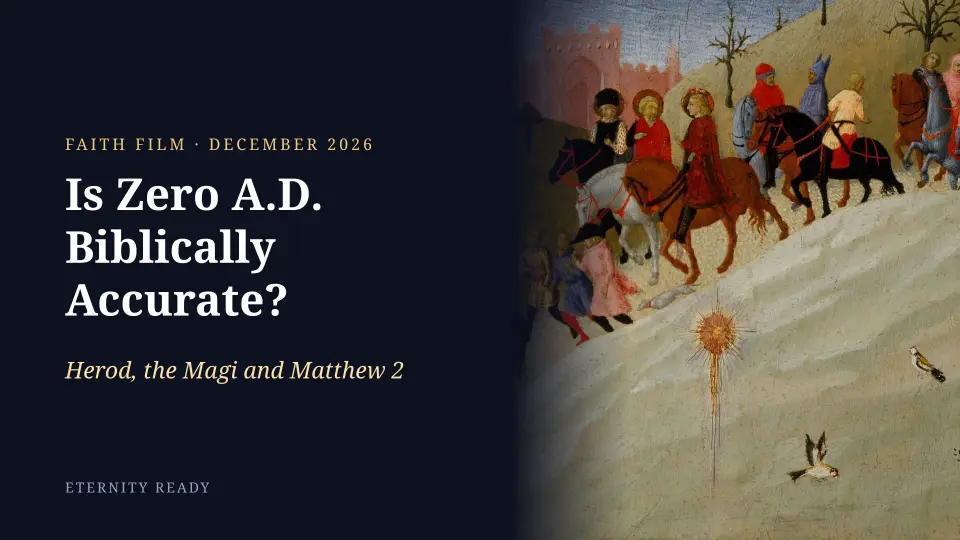
The trailers show a first Christmas with no quiet manger in it: torches in the night, soldiers on the road, a paranoid king and a young mother running for her child's life. So before you buy tickets, it's fair to ask: is Zero A.D. biblically accurate? Angel Studios' Zero A.D.: The Birth of Christ comes from the director of Sound of Freedom and casts Jim Caviezel, who played Jesus in The Passion of the Christ, as King Herod. It is built on Matthew 2, a real chapter of the Bible that most nativity plays skip.
Below: what Matthew 2 and Luke 2 say (KJV), who Herod really was, an honest look at the massacre of the innocents, why there was no year "0 A.D.," what the film adds, and a parents' guide.
How we wrote this: the film opens December 11, and our staff hasn't seen it yet. Everything we say about its scenes comes from the studio, the cast and published reviews, all named and linked below. We'll update this page after opening weekend.
The short answer
Zero A.D. takes its backbone from Scripture and adds a great deal the Bible doesn't say. From what has been published so far:
- From the Bible: King Herod, the wise men and the star, the killing of Bethlehem's boys, the angel's warnings to Joseph and the flight into Egypt (Matthew 2). One reviewer says the film also includes Simeon, the old man in the Temple (Luke 2:25-35).
- From history outside the Bible: Herod's son Antipater, recorded by the historian Josephus.
- From church tradition: Mary's father Joachim, and three wise men, one named Balthazar. Scripture names none of them.
- Invented for the screen: a Satan figure named Nahash who appears to Mary, Antipater leading the massacre, and wise men who arrive before Jesus is born.
The main events are biblical; much of the surrounding story is not. That's true of most Bible films. What matters is knowing which part is which.
Zero A.D. at a glance
- In theaters: December 11, 2026, in the U.S. and Canada, according to Angel Studios. The date has moved twice: it was first set for December 19, 2025, then for December 25, 2026.
- Rated: PG-13 "for strong violent content, bloody images and thematic elements," as reported by CHVN Radio and Colombia One. Australia rated it M.
- Runtime: 1 hour 55 minutes.
- Director: Alejandro Monteverde, who co-wrote the script with Rod Barr. It was developed as Bethlehem, a spiritual thriller, and filmed in Morocco from November 2024.
- Cast: Jim Caviezel (Herod), Deva Cassel (Mary), Jamie Ward (Joseph), Sam Worthington (Antipater), Ben Mendelsohn (Nahash), Gael García Bernal (Joachim) and David Harewood (Balthazar).
On EWTN's The World Over, Caviezel said he took the role after a call from producer Leo Severino and a talk with Mel Gibson. He summed up his character this way: "He had power, but he was worried — who's going to kill him?" Matthew 2 turns on that same fear.
What the Bible actually says: Matthew 2 and Luke 2
Only Matthew and Luke describe Jesus' birth, and each tells a different part. Zero A.D. draws mostly on Matthew.
Matthew 2, scene by scene
Matthew 2 takes about four minutes to read in our free Bible reader.
- Wise men come to Jerusalem. They arrive "in the days of Herod the king," asking for the one "born King of the Jews," because they have "seen his star in the east" (2:1-2).
- Herod is troubled. The chief priests and scribes point him to Micah 5:2: out of little Bethlehem will come "a Governor, that shall rule my people Israel" (2:6).
- A secret meeting. Herod "privily called the wise men" and asked "diligently what time the star appeared" (2:7). Then he sent them to Bethlehem, pretending he wanted to worship too.
- The worship. The star "went before them" and "stood over where the young child was." They entered "the house," found "the young child with Mary his mother," and gave gold, frankincense and myrrh (2:9-11).
- Dreams and escape. God warned the wise men to go home another way. An angel told Joseph to "flee into Egypt... for Herod will seek the young child to destroy him," and Joseph left that night (2:12-14).
- The massacre. Herod, "exceeding wroth," killed the boys of Bethlehem and its coasts "from two years old and under, according to the time which he had diligently enquired of the wise men." Matthew connects it to Jeremiah's words about Rachel weeping for her children (2:16-18).
- Nazareth. After Herod died, Joseph heard that Herod's son Archelaus ruled Judea, so he settled the family in Nazareth in Galilee (2:19-23).
Three details matter later. Jesus is a "young child," not a newborn. The family is in a "house," not a stable. And Herod's age limit comes from when the star first appeared. Together they suggest the wise men came months after the birth, possibly more than a year after.
Luke 2: the other half
Luke 2 fills in what Matthew leaves out: Caesar's census, the trip from Nazareth, and the baby "laid... in a manger; because there was no room for them in the inn" (2:7). Then come the shepherds and the angels. After Mary's purification, the family presents Jesus at the Temple and offers "a pair of turtledoves, or two young pigeons" (2:24). Under the law of Moses that was the offering for a family "not able to bring a lamb" (Leviticus 12:8). There Simeon, promised he "should not see death, before he had seen the Lord's Christ," warns Mary that "a sword shall pierce through thy own soul also" (2:26, 35).
How the two accounts fit
Luke 2:39 says that after the Temple visit the family "returned into Galilee," with no mention of Egypt. Christians have long read the Gospels as complementary: Bethlehem, the Temple about forty days later, a house in Bethlehem where the wise men visit, Egypt, then Nazareth, with Luke skipping ahead. Skeptical scholars see the differences as a sign the stories grew up separately. Either way, the Bible never puts the wise men at the manger with the shepherds. That picture comes from Christmas cards.
Is Zero A.D. biblically accurate? What the film adds and changes
This section lists what reviewers and official sources report, and nothing more.
Antipater: a real son with an invented role
Antipater was Herod's oldest son. In his Antiquities of the Jews, Josephus records that Herod had him executed for plotting against his father, and that Herod died on the fifth day after his son was killed. According to Kevin Keating's review on The Bible Artist, the film gives Antipater a major arc and has him lead the soldiers into Bethlehem. Keating notes no source ties Antipater to the massacre; the Bible never mentions him.
Nahash, the serpent
Ben Mendelsohn's Nahash is a Satan figure who appears to Mary in visions and tempts her. His name is the Hebrew word nachash, which the King James Version always translates "serpent," as in Genesis 3:1. The Gospels never describe Satan visiting Mary.
There is a biblical idea underneath the choice, though. Genesis 3:15 promises enmity between the serpent and the woman's "seed." Revelation 12:4 pictures a dragon that "stood before the woman which was ready to be delivered, for to devour her child as soon as it was born." The film turns that unseen war into a character. Keating adds a theological question about the film's version. Its Nahash seems to know that Jesus must die, but Paul wrote that "none of the princes of this world knew" God's plan, "for had they known it, they would not have crucified the Lord of glory" (1 Corinthians 2:8).
Joachim and Mary's childhood
Keating reports that the film opens with young Mary and her father taking a lamb to be sacrificed. The Bible never names Mary's parents. The names Joachim and Anne come from the Protoevangelium of James, a second-century writing that the Gelasian Decree, around A.D. 500, classed as apocryphal. It still shaped much Catholic and Orthodox tradition about Mary.
Wise men before the birth
Keating says the Magi reach Jerusalem before Jesus is born, and the star appears on the day He is conceived. He likes the star choice as storytelling, but notes that the compressed timeline raises a question: if Herod knew exactly when the baby was born, why kill boys up to two years old? In Matthew, Jesus is already born when the wise men arrive (2:1).
Three kings, one named Balthazar
Matthew gives no number and no names. Three likely came from the three gifts. By about A.D. 500 the Magi were widely called kings, an idea linked to Psalm 72 that John Calvin later rejected. The names Melchior, Caspar and Balthazar first appear in an eighth-century Latin text.
Mary as the hero
Jon Jones of The Peach Review writes that Mary is the film's protagonist, that Joseph is secondary, and that most of the visions and dreams are hers. Keating calls her a larger-than-life figure and says the film implies a miraculous birth without human help, an emphasis he links to Catholic devotion.
Matthew tells it the other way around: every dream in chapters 1 and 2 comes to Joseph or the wise men, and Joseph is the one who acts. Luke honors Mary beautifully. She answers the angel, "Behold the handmaid of the Lord; be it unto me according to thy word" (1:38), she "kept all these things, and pondered them in her heart" (2:19), and she rejoiced "in God my Saviour" (1:47). Protestant viewers will honor her as Scripture does: a faithful, brave young woman who needed a Saviour herself. Catholic and Orthodox families will recognize more of their own tradition on screen.
Who was Herod the Great?
Most of what we know about Herod comes from Josephus, a Jewish historian who wrote near the end of the first century.
- An outsider king. Herod was born around 72 B.C. into an Idumaean family. Rome named him king of Judea, around 40 B.C. by Josephus' dating, and he took Jerusalem around 37 B.C.
- A great builder. He expanded the Temple in Jerusalem, the one Jesus later taught in. He also built Masada, the port of Caesarea Maritima and Herodium, a palace-fortress near Bethlehem. In 2007, Ehud Netzer's team announced they had found his tomb at Herodium, though some archaeologists dispute it.
- A frightened father. Herod executed his wife Mariamne in 29 B.C. He had their sons Alexander and Aristobulus strangled in 7 B.C., and Antipater killed days before his own death. The Roman writer Macrobius, around A.D. 400, credits Caesar Augustus with a pun on the Greek hys (pig) and huios (son): it was better to be "Herod's pig than his son."
- A cruel ending. As Herod lay dying at Jericho, Josephus writes, he had leading men from across the nation shut up in the hippodrome. He ordered them killed when he died, so the country would be in mourning. His sister Salome released them instead.
Most twentieth-century scholars dated Herod's death to 4 B.C., and some recent scholars argue for 1 B.C. Either way, Jesus was born before Herod died, a few years "Before Christ" by our calendar. A king who killed his own sons fits the Herod of Matthew 2.
Did the massacre of the innocents really happen?
The skeptical case. No source outside Matthew mentions the massacre. Josephus details Herod's crimes but doesn't record it, and neither do Philo, Tacitus or Suetonius. A November 2025 article by Marko Marina on Bart Ehrman's website argues that Matthew modeled the story on Pharaoh's order in Exodus 1:22 to present Jesus as a new Moses, and points out that Luke doesn't include it. It cites the historian Michael Grant, who considered it myth or folklore, and says most historians see it as legendary.
The case for history. Others say the silence makes sense once you consider the scale. William F. Albright estimated Bethlehem's population at about 300. Historian Paul Maier estimated six or seven boys aged two and under would have died. Trent Horn of Catholic Answers puts it at no more than a dozen. Gordon Franz of the Associates for Biblical Research notes that Josephus wrote almost a century later and relied on Nicolas of Damascus, Herod's court historian, who had reason to leave it out. Horn adds that Josephus also skipped events we know happened, such as Claudius expelling the Jews from Rome (Acts 18:2). A handful of village deaths would barely register next to the murders of princes.
Where that leaves us. No archaeological find can settle it. The event fits what we know of Herod, and the number of victims was probably small, far below the later traditions of 14,000 or even 64,000. Christians who trust the Gospels have good reason to accept it as history, and they can be honest that it rests on one witness.
Read Matthew's quotation in its setting in Jeremiah 31. Rachel weeps "because they were not," but the next verses say, "Refrain thy voice from weeping... And there is hope in thine end, saith the LORD." Matthew doesn't hide Bethlehem's grief, and he points past it to hope.
Why there was no year "0 A.D."
No calendar has a year zero. The count goes straight from 1 B.C. to A.D. 1.
The system came from Dionysius Exiguus, a monk who lived in Rome from about 500 until around 544. In 525, Pope John I asked him to prepare a table of future Easter dates. Years were then often counted from the emperor Diocletian, who had persecuted Christians. Dionysius refused to honor a tyrant, so he counted from the Incarnation instead: anno Domini, "in the year of the Lord." He started his count at one.
Bede used it in his Ecclesiastical History of the English People (731), and Alcuin and Charlemagne spread it across Europe. Counting years "before Christ" caught on after Denis Pétau popularized it in 1627. Only astronomers use a year 0.
Dionysius probably placed Jesus' birth in 1 B.C. If Herod died in 4 B.C., Jesus was born a few years earlier than that. The exact year is uncertain, but the event is not: "when the fulness of the time was come, God sent forth his Son, made of a woman" (Galatians 4:4).
The wise men and the star of Bethlehem
Gentile stargazers find the King of the Jews, while Jerusalem's priests, who knew where to look, stay home. Explanations of the star include:
- A sign from God. The fourth-century preacher John Chrysostom held that it was miraculous. A star that "went before them" and "stood over" a house (2:9) behaves like no ordinary star.
- Planets. In 1614, Johannes Kepler pointed to conjunctions of Jupiter and Saturn in 7 B.C. Others point to a close pass of Jupiter and Venus in 2 B.C.
- A comet or new star. Chinese and Korean observers recorded an object, possibly a comet or a nova, that was visible for more than seventy days around 5 B.C.
Scripture doesn't say how God did it, only that the star led the wise men to worship. Ed Young's short Christmas Chalk Talk: The Star is a good one to watch with older kids.
Is Zero A.D. OK for kids? A parents' guide
This is not a Sunday school pageant. Jon Jones, who praised the film, writes that it is more violent than typical nativity films. He mentions animal sacrifice, blood in the Temple courts, beatings, hangings and sword deaths, and suggests that viewers who are squeamish about blood look away at times. Keating describes soldiers going from house to house in Bethlehem. The massacre is shown on screen, not only mentioned.
Our age suggestions
- Under 10: Skip it. Children don't need to see the massacre to understand Christmas. Read Luke 2 together and watch a gentler film at home (listed below).
- 10 to 12: It depends on the child. If violence on screen upsets them, wait for the home release, where you can skip scenes.
- 13 and up: Most teens can handle it with a parent beside them, and many will find it moving. Talk about it afterward.
Before you go
- Read Matthew 2 together so your kids know what's coming and which parts are Scripture.
- After it opens, read a detailed parents' review from a source you trust.
- Tell younger teens they can close their eyes or step out anytime.
Questions for the drive home
- Which parts were in Matthew 2, and which did the filmmakers add?
- Herod had an army and a palace, and he was still afraid. Why did a baby frighten him?
- Joseph obeyed the same night (Matthew 2:14). What does quick obedience look like for us?
- Why do you think God let foreign wise men find Jesus first?
- How is the Mary of Luke 1 and 2 like, or unlike, the Mary in the film?
- Jesus escaped Herod as a baby, then gave His life willingly as a man. Why does that matter?
Why Matthew put a dark chapter in the Christmas story
Matthew could have stopped at the gold and frankincense. He didn't, and that's a gift to anyone who has grieved at Christmas: Jesus came into a real world of tyrants and weeping mothers.
The angel had told Joseph, "thou shalt call his name JESUS: for he shall save his people from their sins" (Matthew 1:21). Herod tried to destroy the child, and Herod died. The child grew up, laid down His life on a Roman cross outside Jerusalem, and rose again. Herod's throne is gone, and Jesus' never will be. If that hope is new to you, our page on how to be saved explains it simply, and What Does It Mean to Be Eternity Ready? goes further.
Watch the true nativity story free tonight
You don't need a ticket to see the real story. All of these are free on Eternity Ready.
Free films about Jesus' birth
- Why the Nativity? Dr. David Jeremiah uses both Testaments to explain why Jesus was born of a virgin, in Bethlehem, into a carpenter's family. It's the best companion to Zero A.D. we know of (1 hour 23 minutes).
- JESUS Film (English) follows the Gospel of Luke from the virgin birth to the resurrection and is available in more than 1,800 languages.
- The Story of JESUS for Children: first-century children talk about what they've seen of Jesus. A good choice for younger kids.
- FOR UNTO US: the Gracias Choir retells the Nativity as a musical.
- It's Christmas Again: a boy lands in a field outside Bethlehem on the night Jesus was born.
- Journey of Jesus Christ: Kevin Sorbo's five-part series, beginning with Jesus' birth and mission.
For more, see 30+ free Christian Christmas movies or the full movies page. For this season's other faith films in theaters, see Drummer Boy, Jimmy and Zero A.D.
Christmas sermons
- Jeremiah Johnston: Immanuel in Ink: 700 Years Before Christmas
- Jack Graham: So This Is Christmas
- Chip Ingram: The Great Rescue: God's Amazing Plan
- Tim Keller: Advent: The Glory of the Incarnation
- Levi Lusko: This Will Do, a Christmas Eve message on Luke 1:26-38
More are on our Bible Teachers page, and Christian Christmas radio lists free carol stations.
Read it yourself
Read Matthew 2 and Luke 2 aloud on Christmas Eve in our free Bible with audio, and keep going with Bible in a Year and its daily reminder.
Frequently asked questions
Is the movie Zero A.D. biblically accurate?
Partly. Herod, the wise men, the star, the massacre and the flight to Egypt come from Matthew 2. Antipater's role, Nahash, Joachim, three named kings and the timeline do not. Enjoy it as a dramatization, then read Matthew 2.
Is Zero A.D. OK for kids?
It's rated PG-13 for strong violent content, bloody images and thematic elements, and reviewers say the violence is on screen. We suggest it for ages 13 and up, with a parent. For younger children, try The Story of JESUS for Children.
Who plays King Herod in Zero A.D.?
Jim Caviezel, who played Jesus in The Passion of the Christ (2004) and starred in Sound of Freedom (2023).
Did the massacre of the innocents really happen?
Only Matthew records it, so many historians doubt it. Others note that Bethlehem had perhaps 300 people, so only a handful of boys would have died, too few, perhaps, for Josephus to mention beside Herod's murders of his own family.
When does Zero A.D. come out?
December 11, 2026, in U.S. and Canadian theaters, according to Angel Studios. The date has changed before, so check local showtimes.
Why is it called Zero A.D. if there was no year zero?
The calendar Dionysius Exiguus created in 525 goes from 1 B.C. straight to A.D. 1, so the title points to history's turning point, not a real date.
Sources
- Angel Studios: Zero A.D. official page
- Wikipedia: Zero A.D.: The Birth of Christ
- CHVN Radio: "ZERO A.D. film brings new perspective to Nativity story"
- Colombia One: Jim Caviezel as King Herod in Zero A.D. (Nov. 3, 2026)
- National Catholic Register: Jim Caviezel with Raymond Arroyo on EWTN's The World Over
- Atom Tickets: Zero A.D. rating and runtime
- Kevin Keating, The Bible Artist: "Zero AD: Recap, Review, & Analysis"
- Jon Jones, The Peach Review (Nov. 20, 2026)
- Josephus, Antiquities of the Jews, Book 17 (Whiston translation)
- Wikipedia: Herod the Great
- Trent Horn, Catholic Answers: "Is the Massacre of the Holy Innocents Historical?"
- Gordon Franz, Associates for Biblical Research: "The Slaughter of the Innocents: Historical Fact or Legendary Fiction?"
- Marko Marina on BartEhrman.com: "Massacre of the Innocents"
- Wikipedia: Dionysius Exiguus
- Wikipedia: Anno Domini
- Wikipedia: Biblical Magi
- Wikipedia: Star of Bethlehem
- Wikipedia: Gospel of James (Protoevangelium)
- Blue Letter Bible: Hebrew nachash (H5175)
- Scripture quotations: King James Version

Comments · 0
Be the first to comment.