
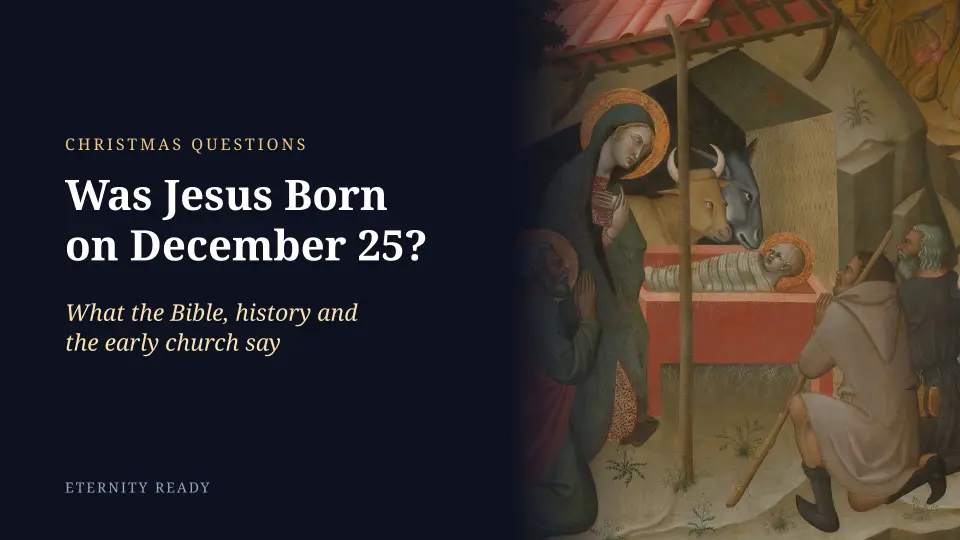
Every December someone at the dinner table asks it: was Jesus born on December 25, or did the church borrow a pagan holiday and paint a manger on it? Maybe you have seen posts claiming Christmas is really Saturnalia, or heard that the shepherds could never have been outside in winter.
Here is the honest answer. The Bible never gives the date of Jesus' birth, and nobody alive today knows it. Most historians place His birth around 6 to 4 BC. December 25 appears as His birthday in Christian writings of the early 200s, and as a church feast in a Roman calendar of the 300s. Historians still debate why: one theory says the church answered a pagan sun festival, the other says early Christians calculated it from the date they believed Jesus died. Both have real evidence. The popular claim that Christmas is Saturnalia renamed is the weakest of all.
Below are the primary sources, the best arguments on every side, and a pastoral answer to the question that matters most: should Christians celebrate Christmas at all?
What the Bible says about when Jesus was born
Luke, who "had perfect understanding of all things from the very first" (Luke 1:3), gives us the political setting, not a calendar date:
And it came to pass in those days, that there went out a decree from Caesar Augustus, that all the world should be taxed. (Luke 2:1, KJV)
We learn that it happened while Herod was king of Judaea (Luke 1:5), during a registration "when Cyrenius was governor of Syria" (Luke 2:2), and that shepherds were "abiding in the field, keeping watch over their flock by night" (Luke 2:8). Matthew adds the wise men, the star, and Herod's order to kill the boys of Bethlehem "from two years old and under" (Matthew 2:16). No month, no day, no season.
Historian Andrew McGowan, in his widely cited Bible Review article, notes that the Gospels are far more precise about the date of Jesus' death, tied to Passover, than about His birth. That detail is the key to one of the two big theories. Read both accounts in the free online Bible: Luke 2 and Matthew 2.
When was Jesus actually born? The year
Herod's death. Matthew and Luke both place the birth while Herod the Great was alive. Josephus tells us Herod died after a lunar eclipse and before a Passover. Since Emil Schürer's chronology of 1896, most scholars have dated that to 4 BC, though a respected minority, including Andrew Steinmann and Rodger Young, defend 1 BC. Add Herod's two-year age limit for the boys of Bethlehem and you get the window most scholars give: roughly 6 to 4 BC.
Why "BC" for the birth of Christ? Our calendar comes from a monk named Dionysius Exiguus, who devised the Anno Domini system in 525 while preparing Easter tables. Nobody knows exactly how he fixed the year of the incarnation, but it appears to land a few years too late; even Pope Benedict XVI said Dionysius made an error. Ancient writers such as Tertullian, Eusebius and Epiphanius put the birth around 2 BC.
Luke's census. Josephus dates a census under Quirinius to AD 6, about a decade after Herod's death, and many critical scholars call Luke mistaken. Bible-believing scholars have proposed solutions: I. Howard Marshall argued the Greek word translated "first" can mean before Quirinius' census; Wayne Brindle proposed that Quirinius held authority in Syria earlier, under Herod. It remains debated, but it is a puzzle about a governor's dates, not about whether Jesus was born.
Working backward. John the Baptist began preaching "in the fifteenth year of the reign of Tiberius Caesar" (Luke 3:1), about AD 28 or 29, when Jesus "began to be about thirty years of age" (Luke 3:23). That loosely fits a birth in the last years BC.
Was Jesus born on December 25? What the earliest Christians wrote
No birthday feast at first. For about two centuries there is no sign Christians celebrated Jesus' birth. McGowan notes that Irenaeus, Tertullian and Origen are silent about it, and Origen mocked birthday parties as pagan. The great feast of the early church was Easter.
Around 200, people start guessing. Clement of Alexandria reports that some in Egypt proposed May 20, others April 20 or 21. He does not mention December 25. The date was genuinely unknown.
Hippolytus (c. 204). The earliest text naming December 25 is in the Commentary on Daniel by Hippolytus of Rome, which dates Christ's birth to the eighth day before the kalends of January, our December 25. Some scholars consider the line a later addition by a copyist. Others, including T.C. Schmidt, who translated the commentary and wrote about it in Biblical Archaeology Review in 2022, argue it is authentic, and textual scholar Roger Pearse judged the Greek reasonably well established. Fair summary: possibly authentic, still disputed.
Africanus (221). The Christian historian Sextus Julius Africanus proposed March 25, the spring equinox on the Roman calendar, as the date of creation and of Jesus' conception. Count nine months forward and you reach December 25.
The Chronograph of 354. The oldest record of December 25 kept as an annual Christian feast is this illustrated Roman almanac, made by the calligrapher Furius Dionysius Filocalus for a wealthy Christian named Valentinus. Its list of martyrs' days opens with December 25 and the birth of Christ in Bethlehem of Judea. The list itself is often dated to about AD 336.
Augustine (c. 400). In On the Trinity, Augustine says Jesus was believed to have been conceived on March 25, the day He also suffered, and adds, "But He was born, according to tradition, upon December the 25th." He also reports that the Donatists, who had split from the church in North Africa decades earlier, kept the same date, a hint that it predates their split.
The East: January 6. Christians in Egypt and Asia Minor kept the birth on January 6, which later became Epiphany, the feast of the wise men. The Armenian Church still celebrates Christmas on January 6.
Why do we celebrate Christmas on December 25? The two theories
Theory 1: The church answered a pagan festival
Developed by the German scholar Hermann Usener in 1889, this is the version most people know. In AD 274 the emperor Aurelian promoted the worship of Sol Invictus, the Unconquered Sun, dedicating a temple to him on December 25, near the winter solstice when days begin to lengthen. Christians, the theory says, replaced the sun's birthday with the birthday of Christ, "the Sun of righteousness" (Malachi 4:2).
There is real evidence. The Chronograph of 354 lists the birthday of the Unconquered, with chariot races, on the same day as Christ's birth. National Geographic notes that Augustine warned Christians to honor the day not because of the sun but because of the God who made it.
But the theory has problems:
- The timeline is tight. The Christian date seems to go back to the early 200s, decades before Aurelian's temple in 274.
- The pagan feast may be later than we think. Scholar Steven Hijmans argues there is no clear evidence of a religious Sol festival on December 25 before the Christian one; the earliest certain evidence, in his view, is the emperor Julian's Hymn to King Helios of 362 or 363. If so, the pagan feast may have answered Christmas, not the reverse.
- No early Christian said it. McGowan points out that no early church writer links the date to a pagan feast. The first surviving claim is a 12th-century marginal note on a manuscript of the Syrian writer Dionysius bar-Salibi.
What about Saturnalia?
Saturnalia, the Roman festival of Saturn, was real and rowdy: feasting, gambling, small gifts, and slaves treated like masters. It began on December 17 and, at its longest, ran to December 23. Some of its customs may have influenced later European midwinter merrymaking.
But notice the dates. Saturnalia never fell on December 25. It ended two days earlier. Religion scholar Robyn Walsh of the University of Miami told National Geographic it would be overly simplistic to call Christmas a direct borrowing from any single pagan festival. And Tertullian, around 200, scolded Christians for joining in Saturnalia: the church saw it as something to avoid, not something to rename.
Theory 2: Early Christians counted from the cross
Proposed by Louis Duchesne and developed by liturgical scholar Thomas Talley in The Origins of the Liturgical Year, this theory starts with Passover. Around 200, Tertullian calculated that the day Jesus died fell on March 25 of the Roman calendar. Many believers held that God's great works fit together, so Jesus was conceived on the same date He died. (McGowan notes a similar idea in the Talmud, linking creation and future redemption to the same month.) March 25 plus nine months is December 25. In the East, where the death was reckoned on April 6, nine months later gave January 6.
That explains why March 25 became the Feast of the Annunciation and why Augustine connects conception and cross in one sentence. McGowan concludes that some Christmas trappings may come from older customs, but the date itself may owe more to Jewish Passover reckoning and Christian theology than to paganism. Kevin DeYoung of The Gospel Coalition agrees.
This theory has critics too. Bernard Botte argued the calculations were invented after the date was already in use, and many academic historians still prefer the first theory or a blend. Talbot School of Theology professor Kenneth Berding adds a caution: even if the calculation explains where the date came from, it does not prove Jesus was born that day. Most scholars date the crucifixion to AD 30 or 33, not to a March 25.
Bottom line: we do not know Jesus' birthday. December 25 was most likely chosen by Christians for Christian reasons, perhaps in conversation with Roman sun worship, and almost certainly not as a rebranded Saturnalia.
Could the shepherds have been outside in December?
Good Bible teachers land on both sides of this one.
Against winter. Many classic commentators thought Luke 2:8 rules out the depth of winter. Albert Barnes judged it "probable from this that our Saviour was born before the 25th of December." John Gill and Heinrich Meyer pointed to cold nights and the rainy season. Bible scholar Ian Paul argues the scene fits mild early autumn better than the cold, sometimes snowy Judean hills in winter.
For winter. Others answer that Bethlehem is not Minnesota. Alfred Edersheim read a Mishnah passage as implying some flocks near Bethlehem stayed out all year, even in February, when rainfall is near its peak. The Cambridge Bible commentary noted that in some pastures of Palestine "the shepherds to this day bivouac with their flocks in winter." (Edersheim's further idea, that these were special Temple shepherds raising sacrificial lambs, is debated, and many scholars say the Mishnah does not prove it.)
The priestly course. Some count from Luke 1:5, where Zacharias served in "the course of Abia," the eighth of 24 priestly divisions (1 Chronicles 24:10). If John was conceived after Zacharias' early-summer service, and Jesus six months later (Luke 1:26), the birth falls around September, near the Feast of Tabernacles. Ian Paul makes this case, but it rests on assumptions Luke never states, such as which of Abijah's two yearly turns is meant. Change one, and the answer moves to spring.
So the shepherds make spring or autumn a little likelier than winter, but they do not settle it.
The Star of Bethlehem: what was it?
Matthew says the star "went before them, till it came and stood over where the young child was" (Matthew 2:9), and the wise men found Him in a "house" as a "young child" (Matthew 2:11). Nativity scenes put shepherds and magi together, but Matthew suggests the magi came later, which fits Herod's two-year age limit.
Natural explanations include:
- Jupiter and Saturn, 7 BC, which met three times that year, as Johannes Kepler found in 1614 (though they stayed nearly a degree apart).
- A comet or nova, around 5 BC, seen for more than 70 days, according to Chinese records.
- Jupiter hidden by the moon, 6 BC, on March 20 and April 17, proposed by astronomer Michael Molnar.
- Jupiter and Venus, June 17, 2 BC, which suits those who date Herod's death to 1 BC.
Many Christians, including John Chrysostom, have seen the star as a miracle, since Matthew has it moving ahead of the magi and stopping over one house. Either way, the nations were being drawn to the newborn King.
Is Christmas pagan?
A date is not a doctrine. Our weekdays still carry the names of pagan gods, yet no believer thinks worshipping on a Thursday honors Thor. What makes worship pagan is who is worshipped. On Christmas morning, Christians read Luke 2 and give thanks that God "sent forth his Son, made of a woman" (Galatians 4:4). That is not the worship of Saturn or the sun.
What about Jeremiah 10? Some sincere believers read "one cutteth a tree out of the forest... They deck it with silver and with gold" (Jeremiah 10:3-4) as a ban on Christmas trees. But the prophet is describing a carved idol that is "upright as the palm tree, but speak not: they must needs be borne, because they cannot go" (Jeremiah 10:5); "the stock is a doctrine of vanities" (Jeremiah 10:8). Jeremiah warns against worshipping a wooden god, not against decorating a tree in a home where Christ is worshipped. Read Jeremiah 10 in context.
Should Christians celebrate Christmas?
Scripture makes it a matter of conscience
The New Testament never commands a celebration of Jesus' birthday, and never forbids one. Paul wrote to believers who disagreed about special days:
One man esteemeth one day above another: another esteemeth every day alike. Let every man be fully persuaded in his own mind. He that regardeth the day, regardeth it unto the Lord; and he that regardeth not the day, to the Lord he doth not regard it. (Romans 14:5-6, KJV)
Let no man therefore judge you in meat, or in drink, or in respect of an holyday, or of the new moon, or of the sabbath days: Which are a shadow of things to come; but the body is of Christ. (Colossians 2:16-17, KJV)
That cuts both ways. The believer who keeps Christmas should not look down on the one who does not, and the one who skips it should not judge the one who keeps it. Read Romans 14 before the family gathers; it is table manners for Christmas dinner.
Christians who chose not to celebrate
Not celebrating has a serious Christian history. The English Puritans and Scottish Presbyterians held that worship should include only what Scripture commands. The Westminster Assembly's Directory for Public Worship (1644/45) recognized only the Lord's Day as holy, and in June 1647 Parliament abolished the feasts of Christmas, Easter and Whitsun. Shops were ordered to open on December 25, and attempts to stop celebrations sparked riots in London, Canterbury, Norwich and elsewhere. Contrary to legend, the ban came from Parliament, not Oliver Cromwell personally, and it ended with the Restoration in 1660.
In 1659 the Massachusetts Bay Colony made celebrating Christmas a crime, with a five-shilling fine. Puritan minister Increase Mather believed the date was chosen because Saturnalia was then kept in Rome. The law was repealed in 1681 under pressure from King Charles II, and Christmas became a public holiday in Massachusetts only in 1856.
These believers were not against Jesus. They wanted to guard pure worship and stop drunken revels that had little to do with Christ. Christians who share those convictions deserve respect.
Why most Christians celebrate
- The event is real. Whatever the date, "the Word was made flesh, and dwelt among us" (John 1:14).
- Heaven celebrated first. The angel brought "good tidings of great joy, which shall be to all people," and a multitude of the heavenly host broke into praise (Luke 2:10-14).
- It opens doors for the gospel. People who never open a Bible will sit through a Christmas Eve service or watch a nativity film with their kids.
- Anything can be done to God's glory. "Whether therefore ye eat, or drink, or whatsoever ye do, do all to the glory of God" (1 Corinthians 10:31).
Keeping Christmas centered on Christ
- Read the story aloud before presents: Luke 2:1-20, plus Isaiah 9:6, written centuries earlier: "For unto us a child is born, unto us a son is given."
- Turn the date debate into a conversation. Nobody knows the day, which is why the event matters more than the calendar.
- Pray for someone by name, or share a request on the Prayer Wall.
- Be gracious with relatives who see it differently.
Watch, listen and read the Christmas story free on Eternity Ready
Nativity and life-of-Jesus movies
- JESUS (the JESUS Film): the classic film based on Luke's Gospel, from the virgin birth to the resurrection.
- Why the Nativity?: why God chose a virgin, a carpenter, shepherds and kings, and the prophecies behind it.
- For Unto Us: the Gracias Choir retells the nativity as a musical film.
- The Fourth Wise Man: Martin Sheen as a magus who spends 33 years searching for the Messiah, based on Henry van Dyke's classic.
- For kids: We Three Kings and The Story of JESUS for Children.
Dozens more are in our guide to free Christian Christmas movies online.
Christmas sermons
- Immanuel in Ink: 700 Years Before Christmas, Dr. Jeremiah Johnston on the prophecies written long before Bethlehem.
- A Christmas Chalk Talk: The Star with Ed Young.
- Chip Ingram's The Hope of Christmas: Jesus: Wonderful Counselor and Jesus: Prince of Peace.
- Advent: The Power of the Incarnation, Timothy Keller.
- Why Christmas Matters, Dr. Myles Munroe, and So This Is Christmas, Jack Graham.
More on the Bible Teachers page.
Christmas radio, all day
Play 24/7 Christmas music on Star Christmas, A Family Life Christmas or Peaceful Christmas from Family Life. The stories behind the season's songs are in our post on Christian Christmas radio, and 300+ more stations are on the radio page.
Read it yourself
Open Luke 1 and Luke 2 in the free online Bible, with audio, or start Bible in a Year on January 1 with a daily reminder email.
Frequently asked questions
When was Jesus' actual birthday?
Nobody knows. The Bible gives no date. Most scholars place the year around 6 to 4 BC, before Herod's death. Proposed seasons range from spring to September to winter; none can be proven.
Is December 25th Jesus' birthday?
Not provably. It is the date the Western church has used since at least the 300s, possibly the early 200s. Even Augustine called it the date handed down by tradition. Christians celebrate the fact of Jesus' birth on that day, not a documented birthday.
Why do we celebrate Christmas on December 25?
Either the church chose it in response to the Roman feast of the Unconquered Sun, linked to Aurelian in AD 274, or early Christians believed Jesus was conceived on March 25, the date they assigned to His death, and counted nine months forward.
Is Christmas pagan?
The heart of Christmas, worshipping the incarnate Son of God, is not pagan. Saturnalia ended on December 23, and whether a pagan sun feast on December 25 came before the Christian one is debated. What makes worship pagan is its object, not its date.
Should Christians celebrate Christmas?
Romans 14:5-6 and Colossians 2:16-17 make it a matter of conscience. Most Christians celebrate it joyfully; some, following the Puritan and Presbyterian tradition, do not, because Scripture does not command it. Both can honor the Lord, and neither should judge the other.
The day matters less than the Child
On a night whose date we were never told, in a town too crowded to give His mother a room, God kept a promise made centuries before. The angel's message was not about a calendar:
Fear not: for, behold, I bring you good tidings of great joy, which shall be to all people. For unto you is born this day in the city of David a Saviour, which is Christ the Lord. (Luke 2:10-11, KJV)
Whether you light a tree on December 25, keep the feast on January 6, or treat every day alike, the question that matters most is not when He was born but whether you have received Him. If you never have, there is no better day than today. Our salvation page explains how, and what it means to be Eternity Ready will help you take the next step.
Merry Christmas, and may the Lord give you His peace in every season.
Sources
- Andrew McGowan, "How December 25 Became Christmas", Biblical Archaeology Society (first published in Bible Review, December 2002)
- T.C. Schmidt, "Calculating Christmas: Hippolytus and December 25th", Biblical Archaeology Review, Winter 2022
- Roger Pearse, "The text tradition of Hippolytus' Commentary on Daniel"
- Augustine, On the Trinity, Book IV, New Advent
- "Chronograph of 354", Wikipedia
- "Date of the birth of Jesus", Wikipedia
- "Sol Invictus", Wikipedia
- "Saturnalia", Wikipedia
- "Herod the Great", Wikipedia
- "Census of Quirinius", Wikipedia
- "Star of Bethlehem", Wikipedia
- "Was Christmas moved to eclipse Rome's Saturnalia festival?", National Geographic
- Kenneth Berding, "Why December 25 for Christmas?", Biola University, The Good Book Blog, December 19, 2023
- Kevin DeYoung, "Is Christmas a Pagan Rip-off?", The Gospel Coalition, December 15, 2020
- Ian Paul, "At what time of year was Jesus really born?", Psephizo
- Commentaries on Luke 2:8 (Barnes, Gill, Meyer, Cambridge Bible), Bible Hub
- Alfred Edersheim, The Life and Times of Jesus the Messiah, Book II
- "When Massachusetts Banned Christmas", History.com
- "Did Cromwell ban Christmas?", The Cromwell Association

Comments · 0
Be the first to comment.